The sample nobody gets cleared
Oceanvs Orientalis spent his life on a legendary 1970s psychedelic-rock band worshipped as gods. Then he built a remix on one of their sacred tracks — and hit the fee that ends most stories. He raised the money in a week, from one investor, without a label.
By the numbers
A record he had to make
Oceanvs Orientalis is not a bedroom hobbyist. 329,000 people a month already listen to him. He has also worshipped one legendary 1970s psychedelic-rock band his entire life — and the remix he built on one of their most sacred tracks was the kind of record that only comes out of that.
Finished. Mixed. Mastered. And completely unreleasable.
The wall: a major-label sample fee
Their catalogue is one of the hardest clearances in music. As far as anyone can establish, only four sample licenses have ever been approved. Getting a yes is the rare part; paying for it is the impossible part.
Sign the track away. The label fronts the fee, owns the master, recoups first, and takes the upside on a record it had nothing to do with.
Write a five-figure cheque out of pocket, before a single stream, against a release date that does not exist yet.
Neither was actually available. So the record sat.
Option C: sell a slice, keep the record
He listed the remix on bushido’s funding tool for accredited investors — not as debt, not as a label deal, but as a share of the future royalties of the derivative work.
One devoted fan funded another
The first cheque came from an accredited investor who was, himself, a devotee of the same band. He wasn’t buying a security abstraction — he was buying 30% of a record he wanted to exist.
Proceeds applied to the sample-license fee and release promotion.
What the investor actually saw
A single private link: ownership maths, total due at checkout, term sheet, release plan. No deck, no lawyer’s introduction, no three-week back-and-forth.
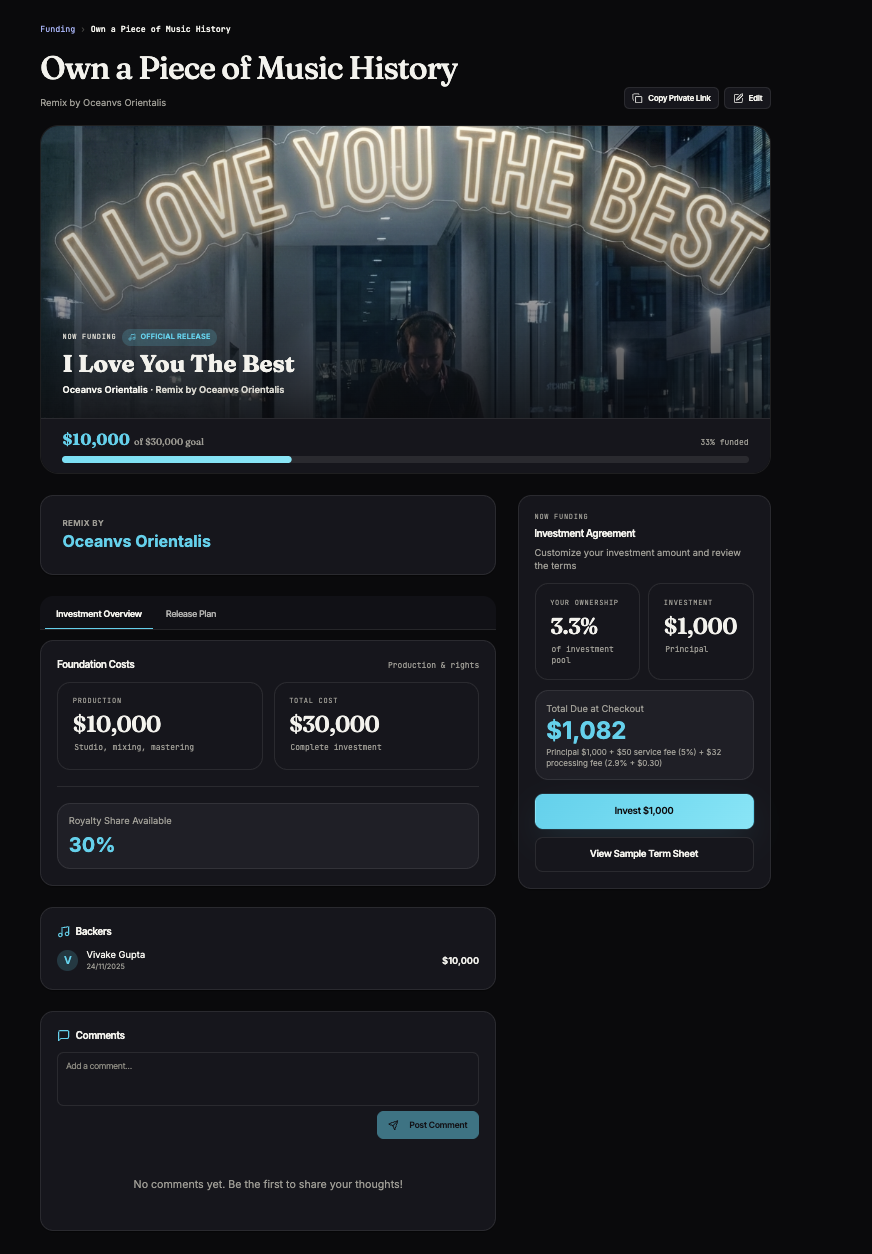
License paid. Release date set.
Where the $10,000 comes back
Streaming services the position. Sync is where a cleared derivative of that catalogue actually pays. Illustrative scenarios on the investor’s 30%:
| Scenario | Net to the track | Investor 30% | On $10k |
|---|---|---|---|
| Streaming only — 5M streams | $17,500 | $5,250 | 0.5× |
| + one independent film placement | $32,500 | $9,750 | 1.0× |
| + one national TV campaign | $92,500 | $27,750 | 2.8× |
| + global brand campaign | $192,500 | $57,750 | 5.8× |
Illustrative only. Figures model plausible net receipts on the derivative work and are not a forecast, a guarantee, or an offer. Actual royalties depend on release performance, DSP rates and sync demand.
In their words
“I don’t need a label to fund the next sample license. I need one investor who gets it.”
Oceanvs Orientalis
bushido turns impossible licenses into fundable assets — so the record decides whether it gets made, not the advance.
Fund your next license